Curaçao speaks regularly about the shortage of affordable housing, the difficulties young families face in buying a home and the rising cost of living. But there is another part of the housing problem that receives far less attention: people who are prepared to build their own homes but cannot move forward because they are waiting for government leasehold land.
For some applicants, that wait can stretch for years.
This raises an uncomfortable but necessary question. When the government considers a complicated issue urgent, it is capable of bringing several departments together, setting deadlines, assigning responsibilities and monitoring progress at the highest level. Why should the same approach not be used for Curaçao residents waiting for leasehold land to build their own homes?
For many families, building gradually has traditionally been one of the most realistic routes to homeownership. They save money, obtain financing where possible and construct according to what their resources allow.
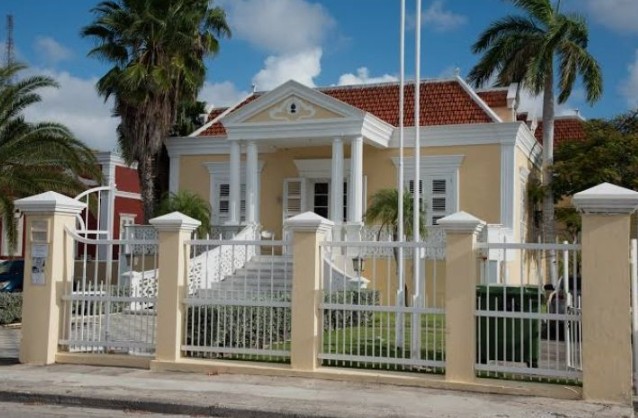
Land Registry Department
But everything starts with one thing: land.
Without it, architectural plans, savings and ambitions mean very little. Every additional year spent waiting can mean another year paying rent instead of investing in a home of one's own.
The problem is bigger than one department
The Ombudsman has already identified some of the weaknesses in the process.
A leasehold application does not simply arrive at Domain Management and result in a plot being handed over. It passes through several stages involving registration, spatial planning, identification and surveying of the parcel, approval, the notary and ultimately registration with the Land Registry.
That complexity helps explain why applications cannot always be handled quickly. But it also reveals the fundamental weakness of the system: when responsibility is spread across several agencies, a delay at one stage can hold up the entire process.
Citizens have complained about slow decision-making, uncertainty surrounding the waiting list and inadequate communication about what is happening with their applications.
That is not merely an administrative inconvenience. Housing is a fundamental social and economic issue, and the Ombudsman has emphasized the government's responsibility to promote adequate housing opportunities.
The solution, therefore, cannot simply be to tell applicants to continue waiting.
Create a special implementation team
Curaçao does not need another committee that spends months studying a problem everyone already knows exists.
What it needs is an implementation team.
Domain Management, Spatial Planning, Public Works, the Land Registry and the relevant utility companies should be brought together under a single coordinated program specifically aimed at leasehold land for residential construction.
One coordinator should have responsibility for tracking stalled applications, identifying where files are getting stuck and resolving problems between government departments.
The starting point should be remarkably simple: How many people are currently waiting? How long have they been waiting? How many government-owned parcels could realistically be prepared for residential construction within the next 12 to 24 months?
Those questions should have publicly available answers.
From there, the government could identify an initial group of parcels and take them through the entire process—from planning and surveying to infrastructure and final allocation.
Progress should be measured monthly: parcels surveyed, applications processed, decisions issued and families actually given the opportunity to start building.
That would turn housing policy from promises into measurable results.
Speed cannot mean political favoritism
There is, however, an important warning.
Accelerating the process cannot become an excuse to bypass the waiting list or distribute scarce government land according to political connections.
If anything, speeding up the process requires greater transparency.
Applicants should receive confirmation of their original application date and be able to determine where they stand in the process. The criteria governing allocation should be public, objective and verifiable.
If there are legitimate reasons why one applicant receives priority over another, those reasons should be clearly defined beforehand.
This is particularly important because government land is scarce. Once the state decides who receives a particular parcel, another applicant necessarily cannot receive that same piece of land.
The Ombudsman's emphasis on equal opportunity and objective criteria therefore deserves serious attention.
Transparency protects not only applicants but also the government itself from accusations of favoritism.
Curaçao should also examine who is buying housing
Government land is only one side of the equation.
Curaçao should also examine what is happening in the private housing market.
Australia offers an interesting example—not necessarily a policy that Curaçao should copy word for word, but one worth studying.
Australia has restricted foreign investors from purchasing existing homes, while encouraging foreign investment to flow toward new housing construction. Authorities also monitor whether land acquired for development is actually being developed rather than simply being held.
The underlying principle is relevant to Curaçao: scarce residential property and land should contribute as much as possible to increasing the housing supply.
That does not mean Curaçao should suddenly prohibit foreigners from buying homes. Tourism, foreign investment and international residents are important parts of the island's economy.
But government should have the data necessary to determine whether investment purchases, second homes, short-term rentals or speculation are removing significant numbers of properties from the residential market available to local families.
If that is happening on a meaningful scale, policymakers should discuss appropriate measures.
But even such measures would not solve the problem facing the Curaçao resident who is ready to build and has spent years waiting for government land.
Self-builders can be part of the solution
There is another reason government should look at these applicants differently.
People willing and financially able to build their own homes are not merely asking government to solve their housing problem for them. In many cases, they are offering to become part of the solution.
They need access to suitable land and a government process that functions.
Every family that successfully builds a home increases Curaçao's housing stock by one unit. Multiply that by hundreds of families and self-construction becomes a meaningful component of national housing policy.
Government does not necessarily have to build every affordable home itself.
It can also create the conditions that allow people to build.
That means identifying land, preparing residential areas, ensuring access to roads and utilities, establishing transparent allocation rules and processing applications within reasonable deadlines.
Urgency must be visible
No minister can solve years of accumulated applications with a signature.
There are genuine constraints. Not every government-owned parcel is suitable for housing. Infrastructure costs money. Spatial planning matters. Utilities must be available. Environmental considerations cannot simply be ignored.
But those legitimate difficulties should not become an excuse for administrative paralysis.
The real question is not whether every person on the waiting list can receive land tomorrow.
It is why applicants still cannot easily see where their application stands, which department is responsible for the next step and when a decision can reasonably be expected.
If Curaçao considers housing a crisis, urgency must become visible in the way government operates.
A dedicated implementation team cannot create land that does not exist, and it cannot eliminate every obstacle. What it can do is establish responsibility, force coordination between departments, expose bottlenecks and produce measurable results.
Most importantly, it can give families something they often lack today: certainty.
Housing policy should not only be about large residential projects, mortgages or government-built homes. It should also recognize the Curaçao resident who has saved, planned and is willing to build a home with his or her own resources.
If government says the housing shortage is urgent, then helping those people gain fair and timely access to available leasehold land must be treated with the same urgency.