For years, Curaçao has been told that reforms within the Kingdom of the Netherlands are based on equality, cooperation, and local ownership. The principle has always been that Curaçao itself determines which reforms are necessary for its development, while the Netherlands provides support through an agreed framework.
However, the latest Dutch financing proposal raises a fundamental question that goes far beyond the amount of money being offered: how meaningful is Curaçao's autonomy when its own reform priorities are barely reflected in the financial decisions being made?
On October 22, 2026, the Curaçao Parliament discussed the possible extension of the Mutual Arrangement for Cooperation on Reforms, known in Dutch as the Onderlinge Regeling Samenwerking bij Hervormingen.
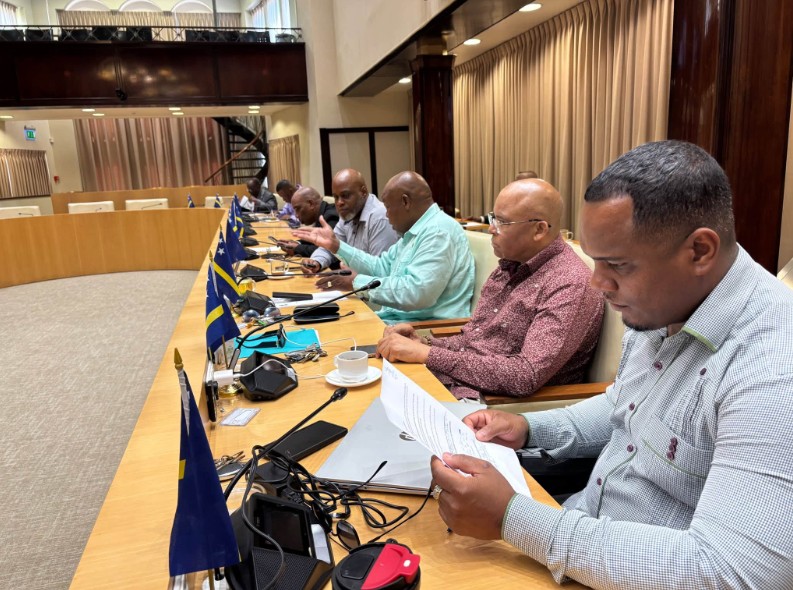
MFK party in Parliament
The Netherlands has proposed extending the cooperation until April 2029, with an additional €8 million, equivalent to approximately XCG 16 million, in financial support.
At first glance, this appears to be a welcome contribution. Curaçao faces significant administrative, financial, economic, and social challenges, and external assistance can help address them.
But a closer examination of the proposed allocation reveals a striking contradiction between the principle of local ownership and the priorities selected for financing.
Forty-One Curaçao Priorities, but Only Five Receive Attention
On June 10, 2026, Curaçao submitted a list of 41 priority reform projects covering nine government ministries.
These were priorities identified by Curaçao itself, reflecting the government's assessment of the institutional and societal challenges requiring attention.
Yet only five of those 41 projects fall within the four areas for which the Netherlands is offering financial support.

Dutch Government
The distribution of the proposed funding is even more revealing.
Of the approximately XCG 16 million available, XCG 10 million is earmarked for the Tax Department, while another XCG 4 million is allocated to financial management.
Together, these two areas account for 87.5 percent of the proposed funding, concentrating the overwhelming majority of the resources within the Ministry of Finance.
Economic development, healthcare, and other pressing social priorities have no separately identified allocation under the proposal.
This raises an unavoidable question: who ultimately determines Curaçao's reform agenda?
If Curaçao identifies 41 priorities but the available financial assistance is concentrated on a small selection, it becomes difficult to argue that the island has complete control over the direction of the reforms being supported.
Of course, the Netherlands is entitled to determine how it wishes to allocate its financial contributions. Curaçao, in turn, has the right to accept, reject, or negotiate those conditions.
But that is precisely where the discussion about equality and autonomy becomes relevant.
A partnership may be voluntary in legal terms while still being unequal in its practical financial influence.
Why Strengthen Tax Collection Without Giving Equal Attention to Economic Growth?
There is no serious argument against improving Curaçao's Tax Department.
An efficient, transparent, and professional tax administration is essential for sound public finances. Citizens and businesses should pay the taxes legally owed, and the government must have the institutional capacity to collect revenue fairly and effectively.
However, taxation is only one side of the economic equation.
Tax revenue does not appear out of nowhere. It depends on businesses generating income, workers earning salaries, consumers spending money, and investors having sufficient confidence to commit capital to the economy.
Without entrepreneurship, investment, employment, and purchasing power, there is no sustainable economic foundation from which taxes can be collected.
This is why the proposed allocation deserves greater scrutiny.
Why is such a substantial amount being directed toward improving tax collection while economic development receives no separate allocation within the Dutch financing proposal?
Would it not make sense to strengthen the economy that produces tax revenue at the same time as the institutions responsible for collecting it?
The two objectives should complement each other.
A government that becomes increasingly effective at collecting taxes without simultaneously addressing the conditions necessary for economic growth risks creating additional pressure on businesses and households already struggling with the cost of living.
This does not mean that modernizing the Tax Department is inherently harmful. It means that tax reform should be considered within a broader economic strategy rather than treated as an isolated administrative objective.
There is also another issue that deserves public attention: the protection of confidential financial information.
Modernizing tax administration often involves new digital systems, information-sharing arrangements, and external technical assistance.
Who will manage these systems? Where will Curaçao's tax information be stored? Which institutions or external service providers will have access to sensitive information concerning Curaçao's citizens and businesses?
Will Dutch government agencies have access to these systems, and if so, under what legal conditions and safeguards?
The information presented does not sufficiently clarify these matters. That does not establish that inappropriate access is planned, but it makes transparency essential.
Curaçao's financial data is not merely an administrative resource. Its protection is also a matter of public trust and institutional responsibility.
Local Ownership Cannot Exist Only on Paper
The Mutual Arrangement signed on April 4, 2023, explicitly identifies ownership, equality, and joint responsibility as guiding principles of cooperation.
These are important commitments, particularly given the long and sometimes difficult history of constitutional and administrative relations between Curaçao and the Netherlands.
However, declarations of equality are not the same as equality in practice.
For many people in Curaçao, skepticism about Dutch involvement in local governance is rooted in decades of experience with political disagreements, financial supervision, and competing interpretations of autonomy.
That skepticism cannot simply be dismissed as opposition to reform or resistance to cooperation.
Nor can it be resolved by repeatedly invoking the same reassuring language.
Trust develops when commitments are reflected in actual decisions.
If Curaçao identifies 41 reform priorities and the Dutch financing proposal covers only five, the government and Parliament should ask whether the arrangement genuinely reflects local ownership.
There may be reasonable explanations for the Dutch selection.
The Netherlands could argue that stronger tax compliance and financial management are essential foundations for effective government. It could also maintain that limited resources require concentrating on a manageable number of projects.
Those arguments deserve consideration.
But they do not eliminate the need to explain why Curaçao's other priorities were excluded from the proposed financing.
Neither should the existence of a financial contribution automatically place the decisions beyond criticism.
The offer does not, by itself, prove that the Netherlands has hidden intentions or is deliberately attempting to undermine Curaçao's autonomy.
What it does reveal is a potentially significant difference between the stated principle of local ownership and the priorities that the proposed funding would support.
That difference deserves an open political debate.
Autonomy Must Be Measured by Decisions, Not Declarations
Article 41 of the Charter for the Kingdom of the Netherlands establishes that the countries independently manage their own affairs.
This principle is central to Curaçao's constitutional position.
Autonomy is not merely the existence of a local government, a Parliament, or the formal authority to approve legislation.
It also concerns the practical ability to determine economic, social, and administrative priorities.
Curaçao must be able to decide which reforms are most urgent for its own development.
Naturally, autonomy does not entitle Curaçao to unconditional Dutch financing. The Netherlands is not legally required to fund every project Curaçao proposes.
But when cooperation is explicitly presented as a partnership based on equality and local ownership, the selection of funded priorities becomes a legitimate measure of whether those principles are being respected.
If the financial resources available under the arrangement are directed overwhelmingly toward priorities favored by the financing partner, Curaçao must consider how much practical influence it retains over the reform process.
This is particularly important when the country faces competing demands for limited resources.
Economic diversification, healthcare, education, infrastructure, administrative efficiency, and social development are not secondary concerns.
They are central to the future of Curaçao.
A reform agenda that concentrates primarily on public revenue and financial administration may improve government finances, but that alone does not guarantee broader economic prosperity or improved living conditions.
Good governance requires both financial discipline and a clear commitment to development.
Parliament Must Demand Answers Before Agreeing to an Extension
The proposed extension until April 2029 should not be treated simply as an opportunity to secure another €8 million.
Parliament has a responsibility to examine the substance of the agreement and determine whether the proposed priorities adequately reflect Curaçao's own development objectives.
That examination should include an explanation of how the five projects were selected, why the remaining priorities were excluded, and whether the financial allocations can still be negotiated.
The government should also clarify whether the proposed funding complements other available resources or effectively determines which reforms will receive priority during the extension period.
Equally important is the question of accountability.
If the arrangement is extended, the public should be able to assess whether the supported projects produce measurable improvements and whether Curaçao's institutions become more capable of functioning independently.
The ultimate objective of reform should not be permanent dependence on external assistance.
It should be the development of strong, professional, accountable institutions capable of serving Curaçao's population.
That is a goal on which both Curaçao and the Netherlands should be able to agree.
The Real Question Is Who Controls Curaçao's Future
The debate over the Dutch financing proposal is not fundamentally about rejecting cooperation with the Netherlands.
Cooperation can be valuable. Financial and technical assistance can help modernize public institutions, improve services, and strengthen government accountability.
But cooperation must be assessed by its substance, not merely by the language used to describe it.
Curaçao should not confuse the availability of external funding with the freedom to determine its own future.
Nor should the government automatically regard every financial offer as beneficial simply because public resources are limited.
The real test is whether the proposed assistance advances the priorities Curaçao has identified for itself.
When 41 locally determined projects are reduced to five within the areas receiving Dutch support, and 87.5 percent of the funding is concentrated on tax administration and financial management, questions about local ownership are not only justified but necessary.
The Netherlands has every right to explain and defend its funding choices.
Curaçao has an equally important responsibility to defend its own priorities.
Ultimately, the question is not simply how much money the Netherlands is prepared to provide.
It is how much influence that money gives the Netherlands over the direction of Curaçao's reforms, and whether Curaçao's elected representatives are satisfied with that arrangement.
If Curaçao genuinely determines its own reform priorities, why are so few of those priorities reflected in the Dutch financing proposal?
And perhaps the most important question of all is this:
When will Curaçao begin measuring its autonomy by what actually happens, rather than by what it is repeatedly promised?