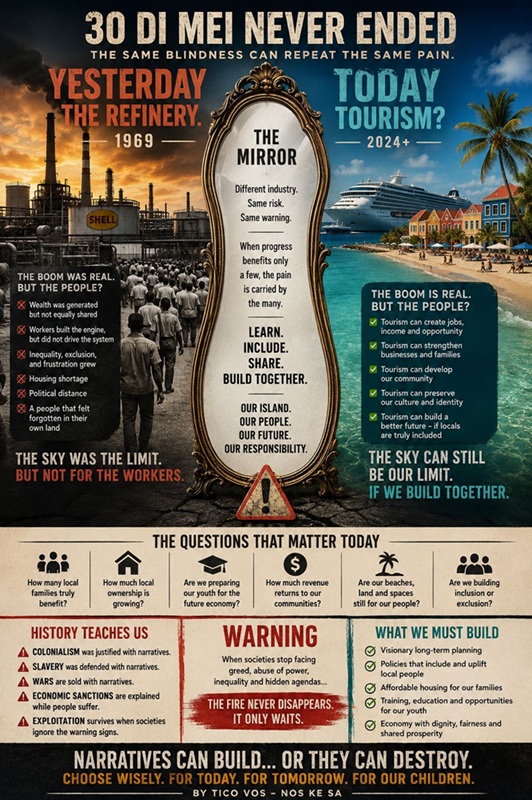
Yesterday the refinery. Today tourism?
The danger of repeating the same blindness under new economic narratives
A contemplation on 30 di Mei 1969
For decades, Curaçao has spoken about 30 di Mei 1969 with carefully chosen words.
Some called it a riot.
Others called it a revolt.
Others preferred “social unrest,” “chaos,” “disturbances,” or “a tragic day.”
But behind every narrative lies an important question:
Who benefits from the way history is explained?
Because the greatest danger is not only what happened on 30 di Mei.
The greatest danger is when societies refuse to honestly confront the conditions that created it.
And then slowly prepare the same conditions again.
In 1969 the signs were already there:
• growing inequality
• concentration of wealth
• foreign economic dependence
• disrespect toward local workers
• social frustration
• lack of equal opportunity
• housing pressure
• racial and class tensions
• political distance from ordinary people
• fear among the population that they were no longer benefiting from their own island
The explosion did not come from nowhere.
It came after years of pressure building underneath the surface while many in positions of responsibility preferred stability over deeper social reflection.
And perhaps one of the most important mirrors between 1969 and today is this:
In 1969, the booming economic engine of Curaçao was the oil refinery.
The refinery dominated the skyline.
The economy revolved around Shell.
Money circulated.
International business flowed through the island.
The refinery symbolized modernity, economic strength, and global importance.
The sky seemed to be the limit.
But underneath that economic success, many workers still felt excluded from the full benefits of the wealth being generated around them.
Many still struggled with inequality, frustration, unequal opportunity, social distance, and feelings that the prosperity of the island was not truly reaching everybody fairly.
And that is where the parallel with today becomes important.
Because today tourism has become the new economic engine.
Hotels rise.
Visitor arrivals increase.
Luxury projects expand.
Cruise tourism grows.
International investors arrive.
Tourism numbers are celebrated.
Again, the sky appears to be the limit.
And tourism absolutely can help Curaçao.
Tourism can generate employment.
Stimulate entrepreneurship.
Strengthen infrastructure.
Support restaurants, transportation, culture, music, small businesses, artisans, guides, photographers, fishermen, and many other sectors connected to the visitor economy.
But history and experience also show something equally important:
Tourism only creates long-term social stability when the development formula genuinely includes the local people, local families, local workers, local entrepreneurs, and local communities as meaningful participants and beneficiaries.
Not only as spectators.
Not only as low-paid labor.
Not only as temporary service providers within an economy increasingly controlled by outside capital.
Because if society is not careful, the island can slowly begin serving what some may call “the god of tourism” — where everything becomes centered around growth figures, visitor numbers, construction, and investment, while deeper social questions quietly remain unresolved underneath the surface.
That is the warning history gives us.
Yesterday the refinery.
Today tourism.
Different industries.
But potentially similar social risks if growth and inclusion do not develop together.
A healthy tourism model therefore cannot focus only on visitor numbers, hotel construction, luxury real estate, or foreign investment flows.
It must also ask:
• How many local families are structurally benefiting?
• How much local ownership is growing?
• How many young Curaçaoans can realistically build a future through this economy?
• How much tourism revenue circulates back into neighborhoods, education, housing, culture, and community development?
• How accessible do beaches, land, and public spaces remain for the local population itself?
• How balanced is the relationship between international investment and local opportunity?
Because tourism without broad inclusion can unintentionally deepen feelings of exclusion inside the very society hosting the industry.
And that is precisely why long-term planning matters.
Not anti-tourism.
Not anti-investment.
But pro-balance.
Pro-community.
Pro-sustainable development.
Pro-Curaçao.
One of the most sensitive discussions today concerns labor and economic planning.
For years, economic sectors have increasingly argued that Curaçao needs additional foreign workers to sustain future growth.
At the same time, many local workers quietly ask:
Are we sufficiently preparing and strengthening our own workforce for the future economy?
This is not a simple question.
Because Curaçao faces real challenges:
• shortage of skilled labor in certain sectors
• rising housing costs
• educational gaps
• demographic pressure
• economic competition in the region
• and the need to maintain tourism and investment growth
But alongside these realities, there is also a growing emotional concern among many citizens that they may gradually feel less connected to the economic future developing around them.
That feeling deserves serious attention.
Not through fear.
Not through division.
But through long-term national planning focused on inclusion, preparation, dignity, and participation.
Because importing labor is not only an economic decision.
It is also connected to housing, infrastructure, education, transportation, healthcare, culture, and social balance.
And if societies fail to carefully prepare for these transitions, frustrations can quietly deepen underneath visible economic growth.
This is precisely why 30 di Mei still matters.
Because social tensions rarely begin suddenly.
They often begin when people slowly feel unheard, uncertain, economically insecure, or disconnected from the future being built around them.
When development happens around them but not sufficiently with them.
When tourism grows but ownership shrinks.
When luxury rises while housing access collapses.
When economic statistics improve while daily dignity weakens.
Today many people therefore ask important questions:
How can tourism growth more directly strengthen local families?
How can economic development create broader ownership opportunities?
How can affordable housing be accelerated?
How can young Curaçaoans realistically build a future on their own island?
How can economic expansion and social stability grow together instead of separately?
These are not anti-development questions.
They are planning questions.
Community questions.
Nation-building questions.
And history warns us what can happen when societies focus only on economic indicators while social concerns continue growing quietly underneath the surface.
After 1969, many focused mainly on the burning buildings.
But fewer wanted to fully examine what had been burning inside society long before the fire reached Willemstad.
That remains one of the most important lessons of 30 di Mei.
Because narratives are never completely innocent.
Sometimes narratives help societies move forward.
But sometimes they can unintentionally minimize deeper problems, delay difficult conversations, or create false confidence that visible economic growth automatically guarantees social balance.
History offers many examples where societies later realized that warning signs had already been visible for years.
Colonialism was once defended through narratives of “civilization.”
Slavery was justified through narratives of racial superiority and economic necessity.
Wars have repeatedly been sold through narratives of security, patriotism, or liberation.
Economic sanctions have often been defended while ordinary human beings quietly suffer underneath them.
Entire systems of exploitation survived because enough people tolerated, repeated, or benefited from dangerous narratives long enough.
That is why societies must always remain alert when powerful interests begin shaping public opinion against vulnerable groups, against workers, against the poor, against local populations, or against those asking difficult questions.
Because once human beings are gradually portrayed as obstacles instead of citizens…
as burdens instead of contributors…
as replaceable instead of valuable…
history shows how quickly societies can lose their moral balance.
And achieving balance demands more than short-term economic thinking.
It demands visionary long-term planning.
Planning with wisdom.
Planning with courage.
Planning with social responsibility.
Planning from the heart.
A development vision that understands that true national progress is strongest when the benefits are shared broadly across society — not concentrated narrowly among a few sectors alone.
Because sustainable development is not simply about constructing buildings.
It is about building stability, dignity, opportunity, trust, and hope for future generations.
30 di Mei therefore is not simply a historical date.
It is also a reminder.
A reminder that sustainable development requires more than buildings and investment.
It requires social balance, dignity, inclusion, and the wisdom to recognize tensions before they grow too deep.
And perhaps that is the deepest lesson history keeps trying to teach humanity.
Narratives are never innocent.
Sometimes narratives educate and protect societies.
But sometimes narratives are carefully constructed to normalize inequality, justify exclusion, protect economic interests, silence criticism, and prepare populations to slowly accept decisions that, over time, may harm the very society they claim to help.
History is filled with examples.
That is why Curaçao — and all societies — must remain careful, balanced, self-reflective, and socially conscious while planning the future.
Because when societies stop honestly confronting greed, abuse of power, inequality, exclusion, and hidden agendas, unresolved pressure never fully disappears.
It only waits.
A strong country is therefore not measured only by how many visitors arrive.
But also by how strongly its own people feel connected to, protected within, and uplifted by the future being built around them.
Yesterday the refinery.
Today tourism.
The question history asks us is simple:
Are we truly learning from the mirror — or only changing the industry while repeating the same social mistakes underneath it?
By Tico Vos
Reporter and Columnist