WILLEMSTAD – Government-owned company 2Bays says it is taking measures to prevent oil spills at the Bullenbaai oil terminal through continuous monitoring, safety procedures, and trained personnel. However, publicly available information does not establish whether the existing safeguards are sufficient to prevent or contain a major oil spill.
In a recent statement published on LinkedIn, 2Bays emphasized that environmental protection is an integral part of its daily operations. According to the company, preventing pollution is a priority, with monitoring systems and established procedures intended to detect potential leaks early and limit the consequences of any incidents.
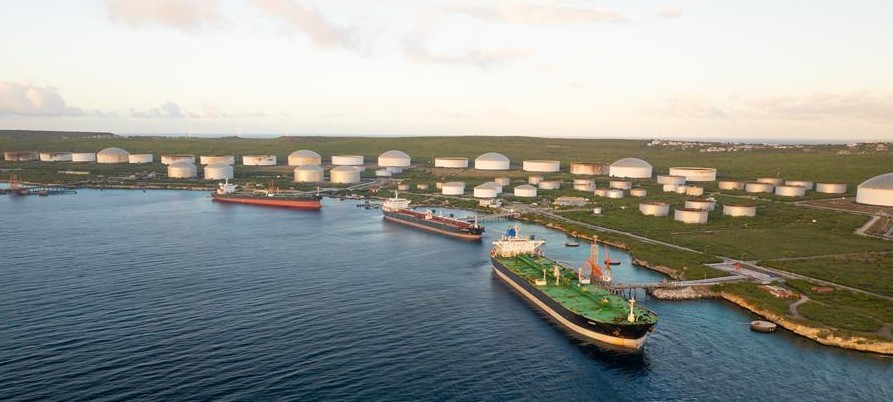
Bullenbaai (Bullen Bay) Curaçao
The statement follows the issuance of a new environmental operating permit, known locally as a hindervergunning, for the Bullenbaai industrial facility.
The Curaçao government granted the permit on August 21, 2026, establishing a formal regulatory framework for industrial activities at the terminal, including environmental requirements that the company must meet.
The permit represents an important development for Bullenbaai, which remains a strategic location for Curaçao's oil storage and maritime activities.
Safety Measures and Emergency Preparedness
2Bays has previously highlighted maintenance activities intended to keep the terminal operating safely.
Company employees have described work involving oil containment systems, firefighting pipelines, and preparations for receiving vessels at the facility.
These systems are important components of industrial safety, particularly at facilities where large quantities of petroleum products may be stored, transferred, or handled.
However, the information made publicly available by 2Bays does not specify the technical requirements established under the new environmental permit.
It remains unclear what standards apply to the capacity of oil containment systems, how frequently equipment must be inspected, and what response capabilities must be maintained in the event of a major spill.
The publicly available company information also does not include results from independent safety inspections or emergency response exercises demonstrating how effectively the terminal's systems would function during a serious incident.
Consequently, while 2Bays has outlined its commitment to preventing pollution, the information released so far does not provide a complete picture of the terminal's preparedness for a large-scale environmental emergency.
Expansion of Industrial Activities
The renewed attention to environmental safeguards comes as 2Bays seeks to develop Bullenbaai into a broader industrial and maritime hub.
In addition to its existing petroleum-related activities, the company is exploring opportunities to attract new businesses and diversify the economic use of the property.
Earlier this month, 2Bays and CurAqua announced a long-term lease agreement for the development of a land-based fish farming facility at Bullenbaai.
The proposed aquaculture operation is expected to have the capacity to produce up to 1,600 metric tons of fish annually.
However, the project still requires the completion of the necessary permits and environmental studies before development can proceed.
The environmental permit issued for Bullenbaai's existing industrial activities does not automatically authorize new projects proposed for the site.
Each additional development must comply with the applicable environmental and regulatory requirements.
The combination of petroleum operations and proposed new industrial activities places additional importance on environmental management and coordination between the various users of the area.
Government Oversight Becomes Central Issue
When granting the environmental permit, the Curaçao government emphasized that economic development at Bullenbaai must take place within the applicable environmental standards.
With the permit now issued, attention is shifting toward how those requirements will be enforced.
An important question is whether the relevant authorities will conduct regular inspections to verify that the terminal's pollution prevention and emergency response systems meet the required standards.
There is also the question of how much information about compliance, inspections, and potential incidents will be made available to the public.
The existence of an environmental permit establishes legal obligations, but compliance must ultimately be demonstrated through operational practices, maintenance records, inspections, and effective oversight.
For an industrial facility handling petroleum products, these safeguards are particularly important because a serious oil spill could have consequences beyond the terminal itself, potentially affecting nearby coastal waters and marine ecosystems.
The available information does not establish that 2Bays is failing to comply with its environmental obligations. Rather, it leaves unanswered questions about the effectiveness of the measures in place and the extent of independent verification.
Environmental Permit Also Planned for Emmastad
2Bays has also announced its intention to obtain an environmental operating permit for its activities in Emmastad.
That process would establish a regulatory framework for another important industrial location under the company's management.
As 2Bays continues pursuing economic development opportunities at Bullenbaai and Emmastad, the effectiveness of environmental oversight will remain an important consideration.
The challenge for both the company and the government is to demonstrate that industrial development can proceed while ensuring that pollution prevention, emergency preparedness, and environmental protection are supported by measurable and independently verifiable safeguards.