One of the most iconic moments in the history of Venezuela occurred on August 3rd, 1806, when Venezuelan Francisco de Miranda, a veteran from the Spanish Army, the American War of Independence, the French Revolution and the Russian Army, landed in the northwestern town of La Vela de Coro becoming the first person ever to hoist the Venezuelan flag on Venezuelan soil. Although such historical account is proverbial among Venezuelans, what is certainly not widely known – neither in Venezuela nor abroad - is that Miranda’s liberation force against Spain in La Vela de Coro – manned by 500 soldiers on 11 ships – had sailed from, and been mostly recruited in, Trinidad, as recounted by Venezuelan historian Carmen Bohórquez in her book Francisco de Miranda. Precursor of Latin American Independencies.
Indeed, Bohórquez further explains that Miranda arrived in Trinidad on June 24th, 1806, 220 years ago today, coming from Barbados, leading his ship, the famous Leander, after his failure against the Spanish at the coastal town of Ocumare, northwest of Caracas, two months earlier. In spite of such a failure, Bohorquez tells us that Miranda knew he was not done, for he still counted on British support via Admiral Alexander Cochrane in Barbados and Governor Sir Thomas Hislop in Trinidad, both of whom assisted him greatly in spite of political constraints.
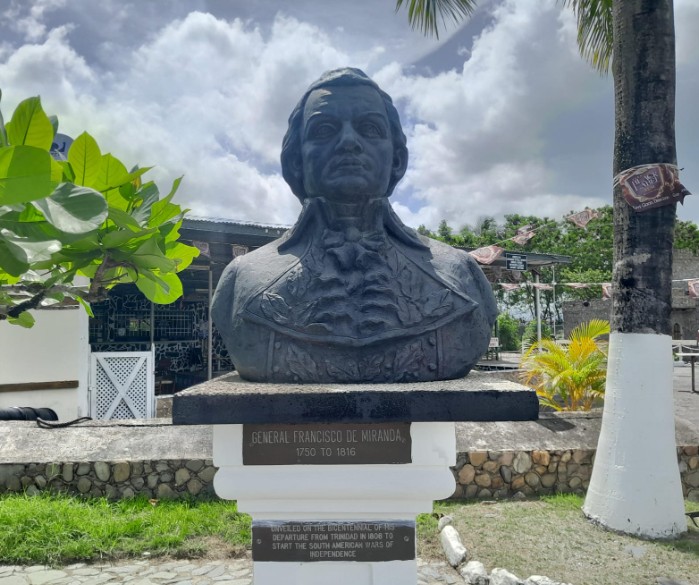
General Francisco de Miranda
But how was Miranda’s stay in Trinidad during those 31 days, from June 24th to July 25th, 1806? To try to answer this question, I have drawn mostly on secondary sources, including two historical novels (which must be read with caution), to approximate Miranda’s activities in Trinidad. So, here you are:
In his book, The Gateway to South America. Trinidad and the South American Revolution, the late Trinbagonian Military Historian Gaylord Kelshall says that Miranda arrived in Trinidad in style, escorted by Royal Navy Ships HMS Express and HMS Lily, and was then accommodated at the Government House as Governor Hislop’s special guest. “No adventurer ever received such treatment in a British colony. It certainly never before happened in Trinidad’s history, nor would such an event ever take place again,” adds Kelshall to describe Miranda’s entrance in Trinidad.
Similarly, the late Trinbagonian Nobel Laurate Vidiadhar S. Naipaul recounts in his historical novel A Way in the World that Governor Hislop would have told Miranda: “You are the most famous man to have come here [to Trinidad]. Before you came, I suppose Commodore Samuel Hood was the most famous man we had here [in Trinidad]. Nelson’s second-in-command at the Battle of the Nile.”
Immediately after such majestic arrival, Miranda set to work, as there was no time to waste. Hence, he went DDI, “Down de Islands,” specifically to Chacachacare, but not for fun though. Kelshall tells us that – unsurprisingly - one of Miranda’s first places where he started his recruiting drive was on Chacachare Island, where Miranda met with Santiago Mariño de Acuma and Doña Atanacia Carige, parents of siblings Santiago Mariño and María Concepción Mariño, both of whom were instrumental, years later, in 1813, in leading another liberation expedition from Chacachacare to the Venezuelan town of Güiria. In fact, Kelshall vividly describes the considerable impression that Miranda made on the Mariño teenagers, while on Chacachacare, resulting in their unconditional loyalty and desire to liberate Venezuela, inspired by Miranda.
Another account, by American James Biggs, one of Miranda’s lieutenants, albeit also an instigator and a ringleader, according to Naipaul’s historical novel, describes Miranda’s recruits in Trinidad as being “low or worthless characters,” as stated in his recollection The History of Don Francisco de Miranda's Attempt to Effect a Revolution in South America. Nonetheless, in it, Biggs refers that “a few of them are respectable men,” adding that “the principal and most respectable persons [of Trinidad] are William Gage Hall, with the rank of colonel of engineers; count de Rouvray, colonel: Chavlier Loppenot, captain of horse, James Adrien, interpreter and officer of engineers; and two Spaniards ranking as colonels…”
Indeed, to promote his military enterprise, Miranda published a handbill, circulated throughout Port-of-Spain on July 21st, 1806, which although described as foolish by Lieutenant Biggs, induced people both Venezuelan and foreigners to join Miranda’s cause. “The glorious opportunity now presents itself, of relieving from oppression and arbitrary government, a people who are worthy of a better fate; who ought to enjoy the blessing of the finest country in the universe, which bountiful providence has given them…” read the said handbill, and it ended with a message to the people of Trinidad: “And you, brave volunteers of the island, who have nobly come forward to partake with us our honours, and to share with us our prosperity, hasten to follow those officers under whose care you have been already trained, and who are impatient to lead you on to victory and wealth.”
But Miranda would have also included enriching and symbolic activities while in Trinidad. In fact, Miranda would not leave Trinidad without paying tribute to one of his closest revolutionary associates, Venezuelan Manuel Gual, who, according to the book General History of Venezuela, by Venezuelan Historian Miguel Ángel Mudarra, had been assassinated by monarchists in Trinidad six years earlier, in 1800, after leading an important insurrection against Spanish rule in Caracas and La Guaira, along with Venezuelan José María España, in 1797.
Moreover, in his historical novel From the Gates of Aksum, the late Trinbagonian Historian Gerard Besson depicts Miranda’s visit to St. Joseph (San José de Oruña, Trinidad’s original capital), with the objective of acquiring Manuel Gual’s death certificate and visiting his tomb. However, to Miranda’s dismay, adds Besson, there was neither a death certificate to be seen nor a grave to be visited, for Gual’s body had been exhumed. Why? Besson explains that Gual would have died from poisoning and then would have been “buried with a funeral service that was heretical, apostate, agnostic and pagan.”
Reading from Besson’s historical novel, one concludes that the friendship between Miranda and Gual was further sealed by freemasonry. The description of Gual’s funeral as “heretical, apostate, agnostic and pagan” refers to the Catholic view of masonic rituals. Besson reminds us that while in exile in Port-of-Spain, Gual would have lived in the headquarters of the Lodge United Brothers, located “in the town-house of the Corsican planter Simon Agostini.”
Also, Trinbagonian Researcher Jalaludin Khan adds in his paper Free Masonery Links with Venezuela and Trinidad and the War for Independence that the Lodge United Brothers, also known by its original French name as Les Freres Unis (first located on Duncan and upper Prince Street, and later near Queen Street, Lavantille, in Port-of-Spain) functioned as a safe harbour for Caribbean, French, Spanish and South American revolutionaries during the late 18th and early 19th centuries.
Moreover, Besson and Khan go further in explaining that in 1798 Miranda would have founded the Lodge “Gran Reunión Americana” in London, “as an ideological society for independence activists,” (Khan). Notably, such was the excitement about Miranda’s visit to Trinidad, among freemasons, that Besson describes in detail the masonic ceremony taking place to welcome Miranda to the United Brothers Lodge in Port-of-Spain. “I relieved him of his martial cloak, plumed, gold-trimmed lieutenant general’s hat and ebony stick with its gold death’s head knob and assisted him with his apron, sash, collar and golden chain of Venerable Grand Maitre of La Gran Reunión Americana, founded by him,” (Besson).
It was then time to leave Trinidad and head towards La Vela de Coro to liberate Venezuela. Biggs’ entry for July 25th is devoted to the sailing, as well as some commentaries about their one-month-stay in Trinidad: “At length we have weighed anchor and bent our course for the land we are to deliver. We are in the Gulf of Paria about 15 miles away from the Port of Spain, becalmed. With the first fair wind we shall run through the Bocas. The maledictions of many and the blessings of few attend us from Trinidad, where we were far from being popular; though individuals of us experienced great hospitality and kindness from some of the inhabitants.”
In his report, Biggs also provides a list of the vessels, as well as other assets, gathered by Miranda in Trinidad before sailing: “The squadron consists of the Leander, 16 guns, Lily, 24, Express, 12, Attentive, 14, Provo, 10; Bull-dog, Dispatch, Mastiff, gun boats of two and three guns; Trimmer and Commodore Barry, unarmed merchantmen.” Interestingly, Biggs state that Miranda boarded the Lily, not his beloved Leander. In A Way in the World, Naipaul would have Miranda saying: “I will not be on the Leander. I will be on H.M.S. Lily. This is Cochrane’s idea: he thinks that if there is a battle the Spaniards will go for the Leander.”
Nevertheless, one important weapon not listed in Biggs’ aforementioned inventory was perhaps Miranda’s most effective one: a printing press. Until 1806 Venezuela did not have a printing press, albeit Trinidad did have one by 1789, and back then Trinidad was a part of the General Captaincy of Venezuela, as referred to by Venezuelan Historian Ildefonso Leal in his book The First Venezuelan Journal and the State of Culture in the 18th Century. Therefore, Miranda’s printing press, obtained in New York and taken with him on the Leander, was meant to be the first one to be delivered in mainland Venezuela, as explained by Mexican Historian Marina Garone Gravier in her essay The Beginnings of the Printing Press in Venezuela from Some Secondary Sources in Mexico. However, Garone Gravier explains that Miranda sold his printing press to Mateo Gallagher and Diego Lamb upon his return to Trinidad after his failure at La Vela de Coro. Ironically, Garone Gravier describes how both Gallagher and Lamb ended up taking Miranda’s printing press to Venezuela in 1808 to be put to the service of the Caracas Gazette, a publication by the Spanish Crown in Venezuela.
With respect to Miranda’s return to Trinidad, after his failure at La Vela de Coro, in 1806, who better than Besson to depict Miranda’s second – and last - arrival in Port-of-Spain, through Fort San Andrés, near Marine Square (currently Independence Square): “He looked good, though, Smart. He was freshly shaven, his uniform impeccable, his diamond-studded sword worn high on the hip, Russian style. His boots gleamed; his spurs jingled. His hair white as snow.”
Undoubtedly Miranda was an influencer of his time, a widely travelled individual in possession of one of the largest libraries back then, with a quite substantial number of followers in the Americas and Europe, as explained by Venezuelan Carmen Bohórquez, among other researchers and historians. This is why as you travel today along the Bay of Chaguaramas in northwestern Trinidad, facing the shining Gulf of Paria, and head inside the Chaguaramas Military History and Aerospace Museum, you will see a scowling bust of General Francisco de Miranda with an inscription that reads: “Unveiled on the Bicentennial of His Departure from Trinidad in 1806 to Start the South American Wars of Independence.” Such is a 20-year-old token of appreciation from Venezuela to Trinidad and Tobago, acknowledging the support provided by Trinidad to Miranda. A heroic deed that still calls for further research and publications to strengthen the indelible cultural and academic relationship that binds both countries together.
By Álvaro Sánchez Cordero, Ambassador of the Bolivarian Republic of Venezuela to the Republic of Trinidad and Tobago