WILLEMSTAD – The newly installed president of the Joint Court of Justice, Sigmar Carmelia, has outlined plans to create more opportunities for Caribbean legal professionals to advance within the judiciary while making the justice system more accessible to residents, regardless of their language or background.
Speaking during his official installation ceremony in Curaçao on Friday, Carmelia emphasized that strengthening local legal talent and ensuring equal access to justice will be among the central priorities of his presidency.
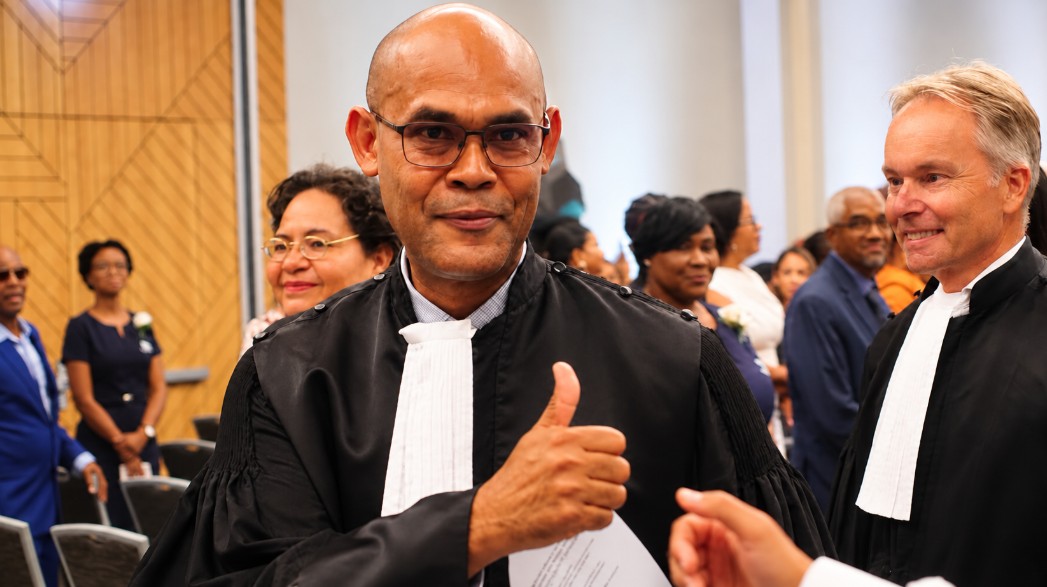
The 49-year-old Curaçaoan is the 26th president of the Joint Court of Justice, which is responsible for administering justice in Aruba, Curaçao, Sint Maarten, Bonaire, Sint Eustatius and Saba.
He succeeds Mauritsz de Kort, who now serves as Governor of Curaçao.
Carmelia was appointed by Royal Decree on May 4, 2026, and sworn into office on May 12. His formal installation took place during an extraordinary session of the Court.
More Opportunities for Caribbean Legal Professionals
One of Carmelia's principal objectives is to advance the Caribbeanization of the judiciary by providing greater opportunities for locally trained legal professionals to develop their careers and assume senior positions within the Court.
According to the new president, the relatively small judicial organization continuously needs qualified professionals to maintain the quality and continuity of justice across the six islands.
He believes that greater attention must be given to identifying, developing and retaining legal talent from within the Caribbean region.
However, Carmelia emphasized that strengthening Caribbean representation does not mean restricting opportunities for judges and other legal professionals from the European Netherlands.
He considers their knowledge, experience and contributions to the diversity of the Court valuable and believes they should continue to play a role in the judicial organization.
His objective is to achieve a better balance by ensuring that qualified Caribbean professionals have meaningful opportunities for advancement.
The Court has already introduced initiatives aimed at encouraging young people to pursue careers in the legal profession.
These include guest lectures at schools and universities, open days and the annual Summer Court program.
Through Summer Court, young legal professionals are given an opportunity to spend several weeks becoming familiar with the work of the judiciary and gaining practical insight into the administration of justice.
Carmelia wants these efforts to contribute to a sustainable pipeline of qualified Caribbean judges and other legal professionals.
Making Justice Accessible in Different Languages
Another priority is improving access to justice for residents of the six islands served by the Joint Court.
Carmelia emphasized that the Court operates in a region characterized by different languages, cultures and legal traditions.
He believes the judicial system must recognize these differences while ensuring that every resident feels heard, respected and protected.
Language barriers can create difficulties for individuals who must appear before a court, particularly when they are required to explain personal circumstances, respond to legal questions or understand judicial proceedings.
To address this challenge, the Court has introduced an interpreter pilot program.
According to Carmelia, the initiative has made it possible for an interpreter to be present at every court hearing, allowing individuals involved in legal proceedings to express themselves adequately.
The president considers language accessibility an essential element of equal treatment before the law.
He also highlighted improvements in the publication of judicial decisions.
The Court has introduced a policy governing the publication of judgments, intended to improve access to judicial information and strengthen transparency.
These measures form part of a broader effort to make the judiciary more accessible and understandable to the public.
One Court Serving Six Different Islands
Carmelia acknowledged the challenges involved in administering justice across six islands with different social, cultural and linguistic characteristics.
Although the Joint Court operates as a common judicial institution, he believes it must remain sensitive to the circumstances of the communities it serves.
At the same time, differences between the islands must not undermine fundamental judicial principles, including equality before the law, legal certainty and judicial independence.
The president emphasized that residents throughout the Caribbean part of the Kingdom must be able to rely on the same fundamental standards of fairness and impartiality.
Maintaining this balance will be an important part of his leadership.
From Curaçaoan Student to Court President
Carmelia's appointment also represents a significant personal achievement.
Born in Curaçao in 1977, he grew up in a family in which his father worked at the refinery and his mother worked as a domestic worker.
During his installation address, he reflected on the important role his parents played in encouraging him to pursue an education and develop a strong sense of responsibility.
After attending Radulphus College, Carmelia studied law in Curaçao and at Radboud University in Nijmegen, the Netherlands.
He returned to Curaçao in 2004 and worked as an attorney for eight years.
In 2012, he began his judicial training, eventually becoming a member of the Joint Court of Justice in 2015.
During his judicial career, Carmelia handled both criminal and civil cases, gaining experience in different areas of the law.
He also served for several years as the Court's press judge and spokesperson, helping explain judicial decisions and developments to the public.
His experience in communicating with the media has given him a public role within an institution that traditionally maintains considerable distance from political and public debate.
Building Public Confidence in the Judiciary
During his installation, Carmelia emphasized that administering justice involves more than interpreting legislation and delivering judgments.
He believes public confidence, mutual respect and a strong sense of responsibility are essential to the functioning of the democratic rule of law.
The new president's priorities reflect two challenges facing the Caribbean judiciary: ensuring that the organization can continue attracting qualified legal professionals and making the judicial process accessible to the diverse communities it serves.
By encouraging the advancement of Caribbean legal talent and addressing barriers to access, Carmelia hopes to strengthen the connection between the Court and the people who depend on it.
His installation marks the beginning of a new chapter for the Joint Court of Justice, with greater local professional development, language accessibility and public confidence at the center of his stated agenda.