“Curaçao is surrounded by sea — yet enjoying it is slowly becoming a luxury.”
Curaçao is surrounded by sea.
Yet a growing number of families are beginning to feel something strange: the island of beaches is slowly becoming an expensive place to simply enjoy the water.
For generations, Curaçao’s coastline was part of everyday life. Families gathered on Sundays at the beach. Children learned to swim in quiet bays. Friends met after work to cool down in the Caribbean sea.
These were not luxury experiences.
They were simply part of Curaçao’s culture.
Today that reality is quietly changing.
Across the island, more and more beaches are becoming controlled environments — beach clubs, resort developments, entrance fees, consumption requirements and increasingly even parking fees.
Tourism is important for Curaçao’s economy. No serious person disputes that.
But a serious question must now be asked:
Who are we really developing the coastline for?
Because something almost unbelievable is happening.
For years investors have been encouraged to build tourism facilities along Curaçao’s most beautiful coastal areas. Governments supported these developments with incentives meant to stimulate economic growth: tax holidays, land concessions, development permits and infrastructure improvements at prime seaside locations.
These policies were intended to strengthen tourism.
But they have also created a troubling paradox.
Facilities built primarily for tourists are now marketed as exclusive beach environments where the very population that once enjoyed these natural bays freely is increasingly expected to pay entrance fees, consumption fees or even parking fees simply to access what was once open public space.
In other words, public policy has helped create tourism infrastructure that gradually controls access to parts of Curaçao’s own coastline.
The local population is slowly being asked to pay to enjoy what was originally theirs.
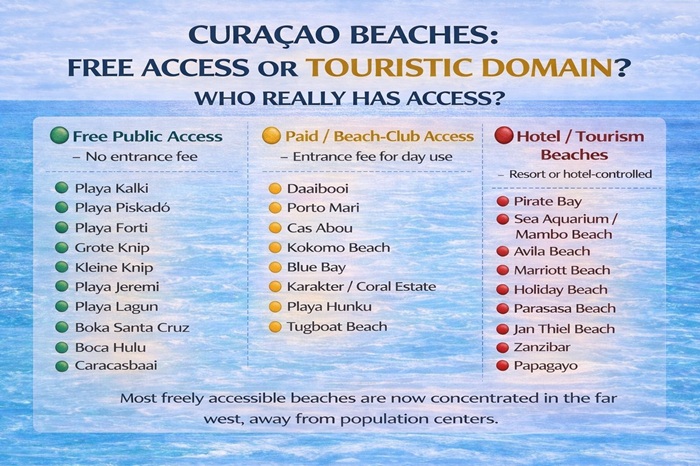
To illustrate this situation, the accompanying graphic groups Curaçao’s beaches into three simple categories.
The green category represents beaches that remain largely free and publicly accessible — places such as Grote Knip, Kleine Knip, Playa Jeremi, Playa Lagun, Playa Forti and Playa Kalki.
The yellow category represents beaches where access is possible but generally involves entrance fees or paid facilities, such as Cas Abou, Porto Mari, Kokomo and Blue Bay.
The red category represents beaches strongly linked to hotel or tourism developments, including Mambo Beach, Avila Beach, Marriott Beach and Jan Thiel.
The graphic does not show geography.
It shows something more important: the structure of access to Curaçao’s coastline.
And it reveals a striking pattern.
Many of the beaches that remain freely accessible are concentrated mainly in the far west of the island — Bandabou.
For many families living near Willemstad, enjoying a free beach now means driving 30 to 45 minutes across the island.
But another question naturally follows:
For how long will the remaining public beaches stay free?
New tourism developments continue to be proposed, and coastal areas are increasingly assigned or leased to private entrepreneurs.
Bandabou — long known as the island’s recreational heart for local families — is also beginning to feel this pressure.
Plans for new resort developments in Banda Abou, including areas around Groot Santa Marta, suggest that the next phase of tourism expansion could reach precisely the regions that currently provide the island’s remaining freely accessible beaches.
Tourism investment can bring jobs and economic growth.
But without careful planning it can also shift the balance between tourism infrastructure and public access to nature.
Once access to a bay or beach is altered by large-scale development, it is rarely easy to reverse.
Geography also plays a role.
Curaçao stretches roughly 65 kilometers from west to east, yet most natural swimming beaches are located along the southwestern coast.
From Willemstad — where most people live — the nearest coastal areas are increasingly dominated by tourism developments and beach clubs.
Bandabou has therefore become not only a beautiful landscape but also one of the last large recreational zones for the general public.
Ironically, every year Curaçao mobilizes significant public resources to manage the large holiday beach weekends, especially during the period leading into Easter vacation.
Police units, tourist police, beach patrols and maritime teams operate with all hands on deck to monitor safety by land and sea as thousands of residents head to the beaches.
This confirms something important:
The beaches remain one of the most important recreational spaces for the people of Curaçao.
Yet the island still lacks sufficient public recreational infrastructure.
Where are the large public parks?
Where are shaded community spaces where families can gather freely?
Where are the green areas designed not for tourists, but for residents?
Around the world, tourism destinations are beginning to confront this imbalance.
In cities in Spain, Italy, Greece and Turkey, local residents have recently protested against the pressures created by over-tourism and the gradual loss of public space.
These protests are not really against tourists themselves.
They are about balance.
Curaçao is far from that situation.
But the lesson is clear.
Tourism should enrich the island — not quietly reduce the spaces that belong to its people.
Because the coastline is not just real estate.
It is part of Curaçao’s collective domain.
An island surrounded by sea should never become a place where its own people struggle to find a free place to enjoy it.
So the question remains:
Who are we fooling?