Why the New BES Aviation Act Offers a Historic Opportunity for All Caribbean Countries and Islands of the Kingdom
Sometimes a political moment emerges that is clearly larger than the issue it appears to address. The recent amendment to the BES Aviation Act is one of those moments.
For many, this legislation is about Bonaire. For me, it is about the future of the entire Kingdom of the Netherlands.
On July 2, 2026, the Dutch House of Representatives approved amendments to the BES Aviation Act, creating a legal framework for introducing Public Service Obligations (PSOs) on essential air routes in the Caribbean part of the Kingdom. This gives the Dutch government the authority to intervene when the market fails to provide affordable, reliable and continuous air connections.
At first glance, many see this as legislation affecting only Bonaire, St. Eustatius and Saba.
I believe it represents much more.
The law provides a unique opportunity to finally develop a comprehensive, long-term vision for accessibility throughout the Kingdom of the Netherlands.
Accessibility Is a Kingdom Interest
Mobility is about far more than transportation.
It determines whether students can pursue their education, patients can receive medical care, entrepreneurs can invest, families can visit one another, and governments can cooperate effectively.
For the Caribbean parts of the Kingdom, aviation is not a luxury.
It is the only realistic means of connecting the countries and islands of the Kingdom.
When air services become more expensive, less frequent or disappear altogether, the consequences are immediate. Economic development, healthcare, education, public safety and social cohesion are all affected.
This applies to Bonaire—but equally to Curaçao, Aruba and Sint Maarten.
An Issue I Previously Placed on the Political Agenda
During my tenure as Curaçao's Minister Plenipotentiary in the Netherlands, I actively placed the affordability of air connectivity within the Kingdom on the political agenda.
When the Netherlands was developing a differentiated aviation tax, I held extensive consultations with members of the Dutch House of Representatives, government ministries and other stakeholders.
My message was always the same:
The Caribbean countries and islands of the Kingdom cannot be treated in the same way as regular intercontinental destinations.
For our residents, air travel is not a commercial luxury—it is an essential public service.
Those discussions contributed to growing political awareness of the issue.
Eventually, Dutch Member of Parliament Peter van Haasen (PVV) introduced a motion requesting that the higher aviation tax not apply to flights to and from the Caribbean parts of the Kingdom. The motion was approved by the House of Representatives and implemented by the Dutch government.
An important principle was thereby recognized:
"Accessibility within the Kingdom requires tailored solutions."
The New BES Aviation Act Opens New Doors
The amended BES Aviation Act represents another important step forward.
It establishes a legal basis for imposing Public Service Obligations whenever the market fails to provide socially necessary air connections.
Under the legislation, requirements may be imposed regarding:
- Flight frequency;
- Maximum ticket prices;
- Minimum transport capacity;
- Continuity of service; and
- Financial compensation to airlines when necessary.
This marks a fundamental shift.
For the first time, the government has an explicit legal instrument not merely to follow the market, but to guide it when necessary.
Why This Also Matters for Curaçao, Aruba and Sint Maarten
This is where the legislation becomes particularly significant.
During parliamentary debate, members of the Dutch House of Representatives specifically raised concerns about air connectivity between the BES islands and Curaçao, Aruba and Sint Maarten.
The government's response is telling.
It acknowledged that these routes could also become vulnerable if the market fails.
In fact, the government's official response to Parliament explicitly states that the new legal framework provides sufficient authority to establish Public Service Obligations in the future on routes between Bonaire and the ABC islands whenever urgent transportation needs exist and market failure occurs.
This means the legislation is not relevant only to Bonaire.
It also creates opportunities for a broader vision regarding the accessibility of Curaçao, Aruba and Sint Maarten.
From Aviation Policy to Kingdom Mobility
That is why I believe this is the right moment to think beyond a single legislative amendment.
We should begin thinking about a shared vision for the future.
I call that vision:
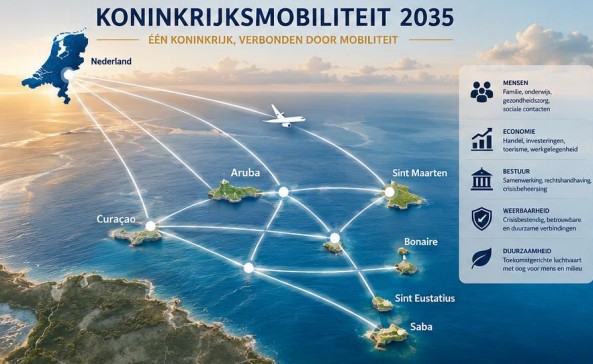
Kingdom Mobility 2035.
Kingdom Mobility means recognizing air connectivity within the Kingdom as strategic infrastructure.
Just as the Netherlands invests in highways, railways and bridges, we must invest in the air connections that literally bind our countries and islands together.
A Kingdom can only function properly when its citizens can actually reach one another.
Four Pillars of Kingdom Mobility 2035
1. Essential Kingdom Air Connections
Identify air routes that are vital to the Kingdom's economic, social and governmental cohesion, and protect them where necessary through Public Service Obligations.
2. Affordable Mobility
Develop joint policies that ensure residents of every country and island continue to have access to affordable air travel without unnecessarily distorting the market.
3. Regional Connectivity
Strengthen connections among Curaçao, Aruba, Sint Maarten, Bonaire, St. Eustatius and Saba to create a more integrated Caribbean region.
4. Kingdom Cooperation
Develop a single aviation strategy in which the Netherlands, Aruba, Curaçao and Sint Maarten work together with Bonaire, St. Eustatius and Saba.
A Moment That Should Not Be Missed
The discussion surrounding Bonaire is important.
But we should not limit it to one island.
The legislative amendment demonstrates that the Netherlands recognizes accessibility as a public interest.
Now is the time to develop that principle further.
Not only for Bonaire.
Not only for the BES islands.
But for every Caribbean country and island within the Kingdom.
My experience as Curaçao's former Minister Plenipotentiary has taught me that meaningful change begins by placing an issue on the political agenda.
The debate surrounding the aviation tax demonstrated that cooperation between the countries of the Kingdom, the Dutch House of Representatives and the Dutch government can produce real results.
The new BES Aviation Act now presents another opportunity.
Let us seize it—not merely to solve today's problems, but to build a future in which mobility is recognized as one of the foundations of the Kingdom.
Because a Kingdom is not united solely by its Charter.
A Kingdom is truly united only when its citizens can reach one another safely, reliably and affordably.
I therefore invite the governments of the Netherlands, Aruba, Curaçao and Sint Maarten to work together on a Kingdom Mobility Strategy 2035.
"A Kingdom is not connected merely by a Charter. A Kingdom is connected when its people can truly reach one another."
Sources
- House of Representatives of the States General, Bill 36 862 – Amendment to the BES Aviation Act introducing a legal basis for Public Service Obligations.
- Explanatory Memorandum to Bill 36 862.
- Government's Memorandum in Response to the Parliamentary Report, including responses to questions from the Christian Union regarding connections with Curaçao, Aruba and Sint Maarten.
- Dutch Government Legislative Calendar – Amendment to the BES Aviation Act.
- Parliamentary debate and adoption of the bill by the Dutch House of Representatives on July 2, 2026.
By Carlson Manuel
Former Minister Plenipotentiary of Curaçao to the Netherlands | Independent Consultant & Strategic Advisor