There is something deeply troubling about the contrast between the image Curaçao presents to the outside world and the reality its own residents experience every day.
Just days ago, Aqualectra welcomed a delegation of Caribbean ministers as part of an investment tour organized by the Curaçao Investment & Export Promotion Agency (CINEX). The visiting officials were on the island for the Caribbean United in Excellence Summit, and the purpose of the tour was to showcase Curaçao's achievements, innovations and economic potential.
Aqualectra was one of the selected stops.
According to CINEX, representatives of the participating companies delivered presentations about their operations, innovations and contributions to Curaçao's economic development. The objective was to demonstrate how the island is positioning itself as a regional example of progress and opportunity.
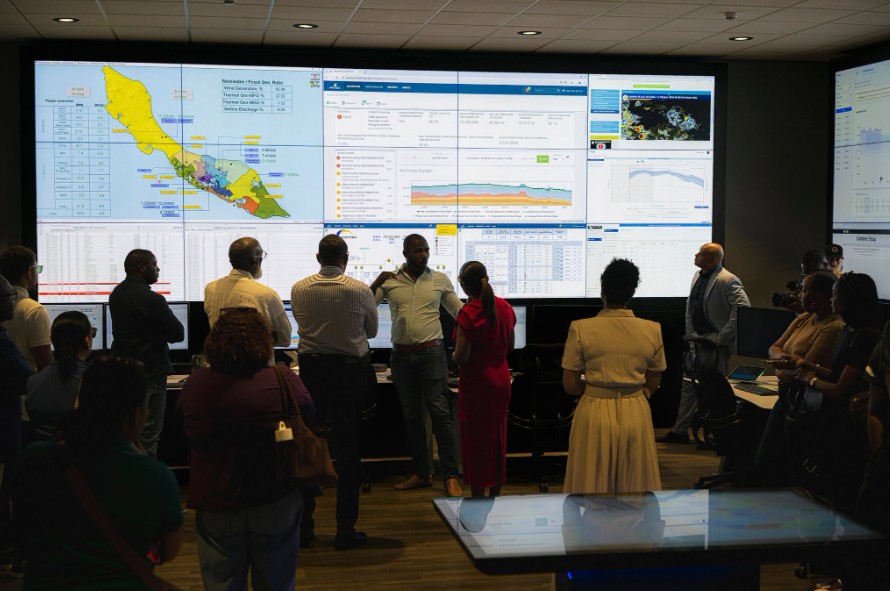
Caribbean leaders attend a presentation at Aqualectra
That sounds impressive.
But there is one question we cannot escape: What exactly was Aqualectra promoting to these Caribbean ministers when it cannot reliably supply electricity to an island measuring just 444 square kilometers?
On Tuesday evening, October 13, Aqualectra warned residents that rotating power outages could begin around 9:00 p.m. because wind speeds were expected to decline during a period of high electricity consumption.
The company explained that a gas turbine that started operating Sunday had already gone offline Monday. Another generating unit developed a pump problem Tuesday evening. Although Aqualectra described the latter as a relatively minor technical issue, it acknowledged that the problem was significant under the circumstances.
The consequence? Households and businesses could once again lose electricity, potentially for two hours at a time.
And Aqualectra could not even tell residents which neighborhoods would be affected or precisely when.
This is the reality behind the presentations about innovation and regional leadership.
Let us be clear. Nobody expects a power company to operate without occasional technical problems. Equipment breaks down. Maintenance is necessary. Unexpected failures occur even in the most advanced electricity systems.
But what Curaçao is experiencing goes beyond an isolated mechanical failure.
For weeks, the island has been dealing with uncertainty over its electricity supply. Residents have been forced to organize their lives around the possibility of power interruptions. Businesses must consider whether their equipment will remain operational. Restaurants, supermarkets and other establishments face the risk of interruptions that can affect their operations and income.
Meanwhile, Aqualectra continues explaining that everything depends on the wind.
When the wind blows, we are fortunate. When it stops, we face the possibility of sitting in darkness.
Is this really the level of energy security Curaçao should accept in 2026?
The issue is not whether renewable energy is desirable. Wind power is an important part of Curaçao's energy future, and investments in renewable generation deserve recognition.
The problem is that renewable energy must be supported by sufficient reliable generating capacity.
Aqualectra itself has acknowledged that its current difficulties stem from a shortage of dependable conventional generation. Its technical management previously explained that several diesel generators were unavailable, leaving the electricity system vulnerable whenever wind production declined.
That is not a surprise created by Tuesday's weather forecast. It is a vulnerability the company has known about.
And this brings us back to the Caribbean ministers.
Imagine being invited to another island to learn about its progress in infrastructure and economic development. You attend presentations about innovation, investment and regional cooperation. You hear about ambitious projects and future opportunities.
Then, shortly afterward, the same utility company warns its own population that it may have to interrupt electricity because the wind is not blowing strongly enough and generating equipment is unavailable.
What message does that send?
We are not suggesting that Aqualectra should hide its investments or refuse to participate in regional exchanges. Curaçao has every reason to present its achievements and seek cooperation with neighboring countries.
But credibility begins at home.
Before presenting ourselves as an example to others, we should be able to demonstrate that we can consistently deliver the essential services our own population pays for.
If anything, Aqualectra should have used the opportunity to speak openly with the visiting ministers about its difficulties and ask whether their countries have experience, technology or expertise that could help Curaçao strengthen its electricity system.
There is no shame in asking for assistance.
There is no shame in acknowledging that something is not working.
The real embarrassment comes when an organization promotes its achievements while customers remain uncertain whether they will have electricity that evening.
We would have respected Aqualectra far more if its message to the visiting ministers had been simple: We are investing in our future, but we are facing serious challenges today. We need reliable generating capacity, better resilience and technical solutions. Let us learn from one another.
That would have been an honest presentation of regional cooperation.
Instead, residents are left reading announcements about gas turbines that stop working, pumps that malfunction and generating units that will hopefully return to service before the end of the month.
Aqualectra says two additional generating units should become operational by the end of October, with another expected by the end of November.
We sincerely hope those deadlines are met.
However, promises about future capacity do not erase the inconvenience and economic consequences of today's interruptions.
Nor should the public be expected to accept uncertainty indefinitely simply because improvements are supposedly approaching.
Electricity is not a luxury. It is essential infrastructure upon which nearly every aspect of modern life depends.
Without reliable electricity, businesses cannot operate efficiently, households cannot plan confidently, and the investment climate that CINEX works so hard to promote becomes less attractive.
This is perhaps the greatest contradiction of all.
Curaçao wants to attract investors. We want international businesses to establish operations here. We want to expand tourism, develop digital infrastructure and convince regional partners that our island offers a dependable environment for economic activity.
But how can we make those promises convincingly when our own electricity system struggles to meet existing demand?
A country cannot build a modern economy on uncertain power supply.
The responsibility does not rest exclusively with Aqualectra's technicians, who are undoubtedly working hard to repair equipment and maintain production. It also belongs to management, the company's supervisory structures and the government as shareholder.
They must ensure that maintenance, investment decisions, contingency planning and electricity generation capacity are aligned with the needs of the country.
And when things go wrong, the public deserves more than reassurance that the situation will improve soon.
It deserves accountability, realistic deadlines and measurable results.
We appreciate Aqualectra's willingness to communicate openly about the difficulties it faces. Transparency is necessary, and the company's acknowledgment of its problems is preferable to silence.
But transparency is only the beginning.
The real measure of success is not how effectively a company explains its electricity shortages. It is how effectively it prevents them.
Curaçao is a small island with enormous ambitions. We want to be a leader in tourism, technology, logistics, renewable energy and regional cooperation.
Those ambitions are legitimate.
But they must rest on a solid foundation.
And that foundation begins with something as basic as keeping the lights on.
Before we invite Caribbean ministers to admire our achievements, perhaps we should first make certain that the people living on these 444 square kilometers can depend on the electricity they pay for.
Because regional leadership is not demonstrated through presentations.
It is demonstrated through performance.
And right now, the people of Curaçao deserve better.