WILLEMSTAD – Prime Minister Gilmar Pisas has used a meeting with members of the Dutch House of Representatives to renew Curaçao’s demand for greater equality within the Kingdom of the Netherlands, emphasizing the need for independent dispute resolution and an end to what the government considers the democratic deficit in Kingdom decision-making.
The discussions took place on Wednesday, October 21, when Curaçao’s Council of Ministers received a delegation from the Dutch parliamentary Standing Committee on Kingdom Relations.
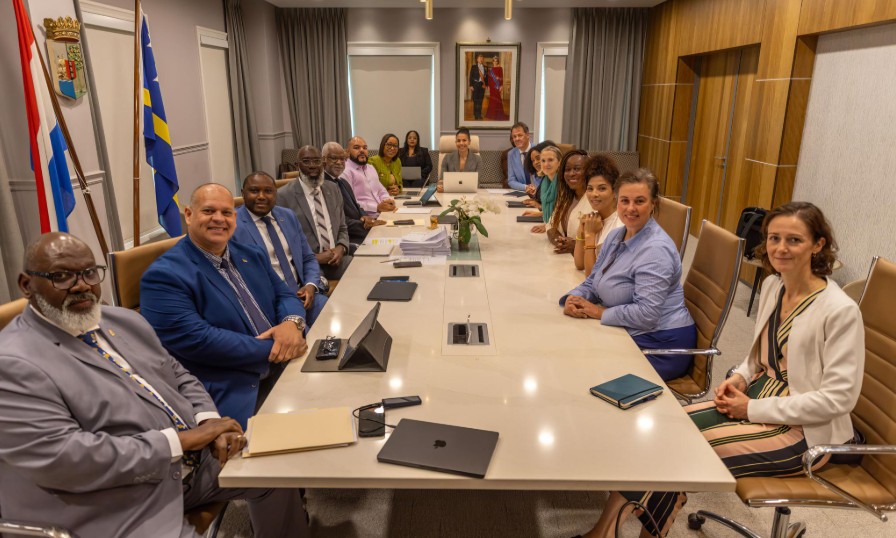
The delegation was led by committee chair Anouschka Biekman and included Heera Dijk of D66, Nicole Maes of the VVD, Mikal Tseggai of PRO, Tijs van den Brink of the CDA, and Annabel Nanninga of JA21. Committee clerk Brechje Hessing-Puts also participated.
The visit formed part of a broader parliamentary working trip to Aruba, Bonaire, and Curaçao, scheduled from October 19 through October 22, according to the official agenda of the Dutch House of Representatives.
Pisas emphasized the importance of maintaining direct communication with Dutch parliamentarians, separate from the formal discussions between the governments of Curaçao and the Netherlands.
He said these exchanges provide an opportunity to address questions concerning the functioning of the Charter for the Kingdom of the Netherlands and the constitutional relationship between the countries.
The Charter establishes the constitutional framework governing the relationship between the Netherlands, Aruba, Curaçao, and Sint Maarten.
Although the four countries have their own governments and responsibilities, certain matters are handled at the Kingdom level. This arrangement has generated longstanding disagreements over the influence that the Caribbean countries can exercise over decisions affecting their autonomy.
One of the central concerns raised by Pisas was the democratic deficit within the Kingdom.
The term refers to the limited direct influence of the Caribbean countries on certain decisions taken at the Kingdom level, even when those decisions affect their internal governance.
For Curaçao, the issue is particularly sensitive when Kingdom decisions involve areas closely connected to the country's autonomous responsibilities.
The government wants these constitutional questions to receive renewed attention during the Kingdom Conference that Curaçao will host in the first quarter of 2027.
Another priority is the establishment of an independent mechanism for resolving disputes between the countries of the Kingdom.
Curaçao has repeatedly argued that disagreements over the interpretation and application of the Charter should be subject to impartial adjudication rather than being resolved solely through political negotiations.
The proposed dispute resolution mechanism is intended to provide greater legal certainty when conflicts arise over the division of responsibilities and powers within the Kingdom.
These institutional questions are expected to be central topics at the 2027 conference, alongside broader discussions about the functioning of the Charter.
The meeting also addressed preparations for the Kingdom Summit scheduled for November 17 and 18, 2026, in Sint Maarten.
During earlier discussions with Dutch State Secretary for Kingdom Relations Eric van der Burg, the Curaçao government indicated that the summit would address security, including cybersecurity, climate change, and financial and economic development. Curaçao also intends to raise poverty reduction as a national priority.
The government presented its Nation Building program as an important instrument for strengthening vulnerable neighborhoods and addressing poverty.
Minister of Economic Development Roderick Middelhof also briefed the Dutch delegation on efforts to improve food security and develop the agricultural sector, particularly preparations for the Agrarian Park Sint Joris project.
The discussions demonstrated that Curaçao's relationship with the Netherlands extends beyond constitutional disagreements and includes cooperation on economic development, social policy, and institutional reform.
Nevertheless, Pisas made clear that questions about autonomy and equal treatment remain fundamental to the government's approach to Kingdom relations.
The prime minister reaffirmed Curaçao's commitment to continued cooperation while stressing that independent dispute resolution and addressing the democratic deficit are essential to a sustainable constitutional relationship.
The upcoming Kingdom Conference will provide another opportunity for the countries to examine these longstanding issues.
Whether the discussions will produce concrete agreements remains uncertain. The government's announcement did not indicate that the Dutch delegation made specific commitments regarding constitutional reform or a dispute resolution mechanism.
For Curaçao, the significance of the meeting lies in bringing these concerns directly before Dutch lawmakers who participate in parliamentary oversight of Kingdom affairs.