WILLEMSTAD – For decades, scientists have debated how multicellular life first emerged on Earth. Some researchers have argued that individual single-celled organisms began sticking together to form larger structures, while others have maintained that multicellularity arose when dividing cells remained attached after splitting. Although examples of both processes have been documented, the prevailing assumption was that multicellular life evolved through only one of these mechanisms.
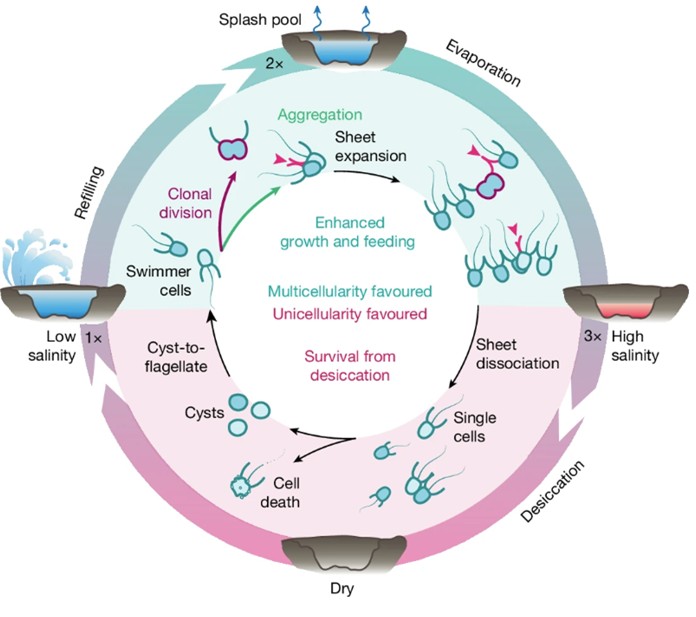
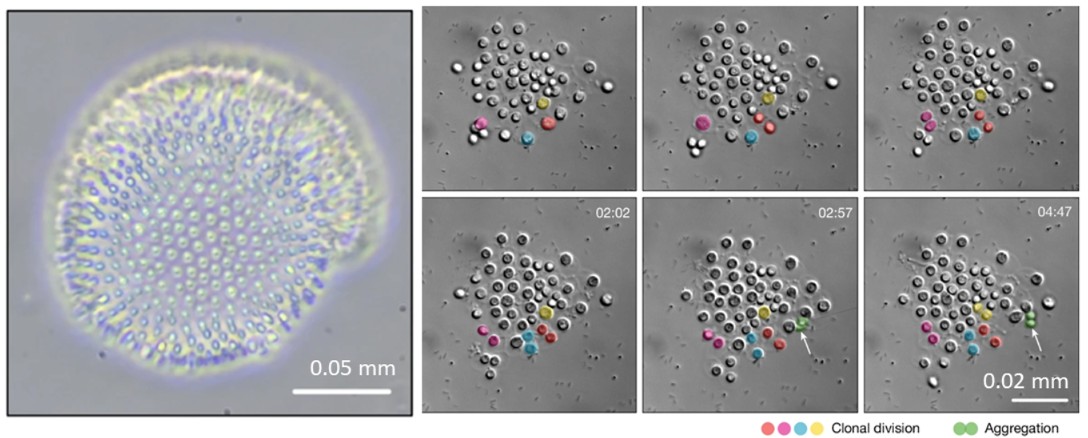
A new study conducted in Curaçao, recently published in the scientific journal Nature, now demonstrates for the first time that multicellular life can arise through a combination of both cell division and the aggregation of separate cells.
Several years ago, a previously unknown colony-forming microorganism was discovered by chance on the north coast of the island in Shete Boka National Park. The organisms were found in shallow pools formed by splashing seawater. These microorganisms, known as choanoflagellates, were already recognized by scientists as the closest living relatives of animals and are considered among the earliest ancestors of multicellular organisms.
Choanoflagellates possess a single flagellum used for movement or capturing food. The Curaçao specimens were studied by researchers from the University of California and the Caribbean Research and Management of Biodiversity Foundation (CARMABI).
Mark Vermeij, one of the researchers involved in the study, explained that traditional theories about the emergence of multicellular life often exclude one another. “In other words, multicellular life was thought to arise either from dividing cells that remained attached or from independent cells that aggregated and stayed together. Our new findings show that these two processes do not have to be mutually exclusive and reveal new ways in which multicellular life on Earth could have evolved,” he said.
The research team found that the colony changes shape depending on environmental conditions such as light intensity and salinity in the surrounding water. When light levels shift, individual cells cluster together into chain-like structures with their flagella pointing outward, allowing the colony to swim. This coordinated transformation indicates organized behavior within the colony.
When salinity levels increase, the chains break apart into individual cells. Using advanced microscopic techniques, the researchers also observed that some cells within the chains divide, with newly formed cells becoming integrated into the existing structure. When salinity rises further, the chains once again disassemble into separate cells. When salt concentrations drop, the individual cells often regroup to form colonies again.
According to the researchers, these dynamic changes in colony formation — including both aggregation and clonal cell division — provide important clues about how complex multicellular life may have evolved from simpler ancestors such as choanoflagellates in response to changing environmental conditions.
The study, titled Clonal-aggregative multicellularity tuned by salinity in a choanoflagellate, was published in Nature on February 25, 2026, by Ros-Rocher N., Reyes-Rivera J., Horo U., Combredet C., Foroughijabbari Y., Larson B.T., Coyle M.C., Houtepen E.A.T., Vermeij M.J.A., Steenwyk J.L., and Brunet T.