Why Does This Detail Keep Appearing?
A Reflection on Identity, Migration, Belonging, and the Stories We Choose to Tell
Following Curaçao’s qualification for the FIFA World Cup, one particular observation appeared repeatedly in analyses, commentaries, interviews, social media discussions, and news reports.
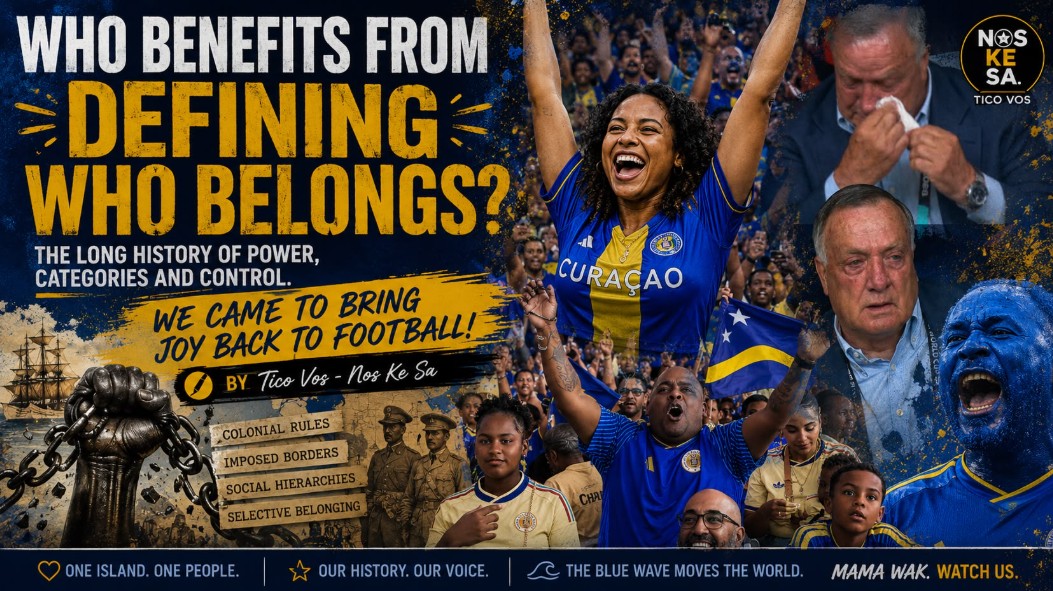
“Only one player was born in Curaçao.”
The statement may be factual.
But the question is not only whether it is true.
The deeper question is: why is this particular fact repeated so often?
Out of hundreds of possible observations about Curaçao’s remarkable achievement, why does this one repeatedly rise to the surface?
Why not emphasize that a small Caribbean island with limited resources reached football’s greatest stage? Why not focus on the remarkable contribution of Curaçaoan families spread across generations and continents? Why not celebrate the strength of a diaspora that maintained emotional, cultural, and family ties strong enough to inspire players to represent Curaçao?
Instead, many discussions return to the same point.
Only one player was born in Curaçao.
Why?
Facts Are Never Just Facts
Communication specialists understand something important.
Facts matter. But the selection of facts matters too.
Every story contains hundreds of facts. Journalists, commentators, politicians, and institutions decide which facts deserve attention and which do not.
This process is called framing.
Framing does not require deception. Framing does not require conspiracy. Framing simply influences how audiences interpret reality.
Consider the difference between these two statements:
“Curaçao qualified for the World Cup despite having a population of roughly 158,000 people.”
Or:
“Only one player was born in Curaçao.”
Both statements may be true.
Yet they lead readers toward very different conclusions.
The first highlights achievement.
The second invites questions about authenticity.
That difference deserves examination.
What Is Being Measured?
The repeated emphasis on birthplace raises an interesting question.
What exactly is being measured?
Birthplace? Identity? Culture? Loyalty? Belonging? Ancestry? Family history? Personal choice?
Modern societies increasingly struggle with these questions.
Migration has become a defining feature of our era. Millions of people live in countries different from those of their parents or grandparents.
Football reflects that reality.
A player may be born in Amsterdam, raised in Rotterdam, have parents from Curaçao, grandparents from Curaçao, speak Dutch and Papiamentu, spend summers with family in Curaçao, feel emotionally connected to Curaçao, and choose to represent Curaçao.
Which identity is the authentic one?
The answer is rarely simple.
The Dutch Context
The discussion becomes even more interesting when viewed through a Dutch lens.
For decades Dutch society used distinctions such as autochtoon and allochtoon. The classifications eventually disappeared from official use, but the debates surrounding identity never disappeared.
The underlying question remained:
Who truly belongs?
Who is considered naturally Dutch?
Who is considered Dutch with qualifications attached?
Many people from Curaçao, Suriname, Turkey, Morocco, Indonesia, and elsewhere encountered these questions personally.
A person could be born in the Netherlands, study there, work there, pay taxes there, and still be described through the language of origin.
Sometimes ancestry mattered more than birthplace.
Sometimes birthplace mattered more than ancestry.
The criteria seemed to shift depending on the discussion.
That observation is important because it appears again in the football debate.
The Curaçao Paradox
This creates what might be called the Curaçao paradox.
When Curaçaoan families migrate to the Netherlands, their Caribbean roots often remain part of the conversation.
Yet when descendants of those same families choose to represent Curaçao, some observers suddenly emphasize their Dutch birthplace.
In one situation, ancestry becomes important.
In another situation, birthplace becomes important.
The criteria move.
The goalposts shift.
And whenever criteria shift, it is worth asking why.
Diaspora Is Not New
Perhaps another assumption should be challenged.
The idea that a nation consists only of people physically born within its borders is relatively recent.
Throughout history, diasporas have shaped nations.
The Irish. The Jews. The Armenians. The Lebanese. The Chinese. The Indians. The Cape Verdeans. The Surinamese. The Curaçaoans.
Migration does not automatically erase identity.
In many cases, it expands it.
Diaspora communities often become extensions of the nation itself. Their children may be born elsewhere. Their emotional connections may remain strong. Their sense of belonging may remain real.
The modern world is full of such examples.
Why Does It Matter?
Perhaps the deeper question is not about football at all.
Perhaps it concerns something older.
For centuries colonial societies developed habits of classification.
People were categorized. Ranked. Sorted. Defined. Measured. Accepted. Excluded.
Sometimes openly. Sometimes subtly.
The categories changed.
The habit remained.
The desire to determine who is truly authentic never completely disappeared.
Perhaps that is why the repeated emphasis on birthplace deserves reflection.
Not because the fact is necessarily wrong.
But because the repetition itself may reveal something.
It may reveal an ongoing discomfort with identities that refuse to fit neatly into traditional categories.
The More Interesting Story
Perhaps the most revealing fact is not that only one player was born in Curaçao.
Perhaps the most revealing fact is that this detail is repeated so often that it begins to overshadow a far more remarkable story.
A small Caribbean island qualified for the FIFA World Cup.
Players with Curaçaoan roots chose Curaçao.
Families maintained connections across generations.
A diaspora strengthened rather than weakened the nation it came from.
And a people often underestimated demonstrated once again that talent does not depend on population size.
That story seems far more interesting than a birth certificate.
A Final Question
Maybe the real question is not:
“Where were the players born?”
Maybe the real question is:
Why do we continue searching for reasons to qualify belonging?
Why do we feel compelled to decide who is authentic and who is not?
Why are modern societies still so fascinated by drawing lines around identity?
And why does the success of a small island sometimes generate more discussion about who belongs than about what was actually achieved?
Those questions extend far beyond football. They reach into history, migration, colonial memory, politics, and perhaps even into the way we understand ourselves.
Because in the end, the most important story may not be where the players were born.
The most important story may be why that question matters so much to us.
Coming Next
Yet one question remains.
Why have societies throughout history been so determined to classify people?
Who is native? Who is foreign? Who belongs? Who does not? Who is authentic? Who must continually prove themselves?
These questions did not begin with football. They did not begin with migration. They did not begin with Curaçao.
They reach deep into the history of empires, colonial expansion, racial hierarchies, citizenship laws, and the enduring tendency of powerful institutions to define reality for others.
In our next reflection, we will examine a more uncomfortable question:
How have powerful societies throughout history created categories that appear objective, while applying them selectively whenever it suits political, economic, or cultural interests?
Because perhaps the most important issue is not who belongs.
Perhaps the real issue is who has traditionally possessed the power to decide.
By Tico Vos
Reporter, Activist and Columnist