WILLEMSTAD – The Colombian guerrilla organization National Liberation Army (ELN) has significantly expanded its influence over cocaine trafficking routes along the Colombian-Venezuelan border, with international smuggling networks using Venezuelan territory to transport drugs toward the Caribbean, including Aruba, Bonaire, and Curaçao, before moving shipments onward to Europe.
The developments were documented in an investigation by the international organized crime research platform InSight Crime, which examined how the ELN has strengthened its position in the cocaine trade and expanded its operations into Venezuela.
The investigation, published on December 8, 2025, describes how the guerrilla movement has evolved from an organization primarily collecting payments from coca producers into a group increasingly involved in cocaine production, processing, and transportation.
The findings have important implications for the security of the Dutch Caribbean islands, which are situated close to Venezuelan coastal areas used by international drug trafficking networks.
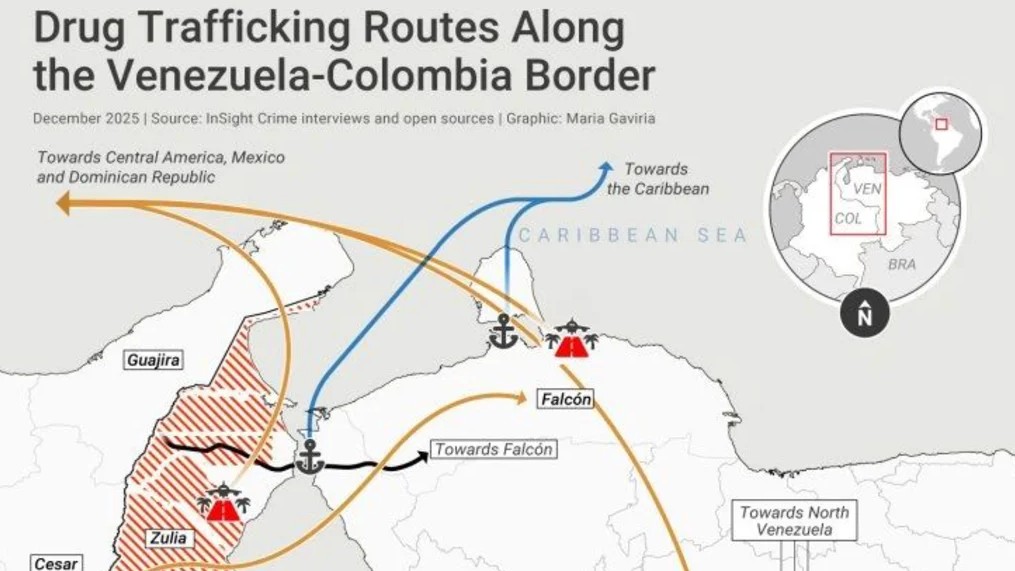
According to InSight Crime, the ELN consolidated its control over large parts of Colombia's Catatumbo region in January 2025. Catatumbo, located along the Venezuelan border, is one of the world's major coca-producing regions and has long been contested by armed organizations seeking control over lucrative drug trafficking activities.
The ELN's growing influence in this region has strengthened its access to trafficking corridors extending into neighboring Venezuela.
Investigators identified Venezuela's Zulia state as an important transit area for cocaine originating in Colombia.
From there, shipments can move toward the Caribbean through several routes, including Lake Maracaibo and coastal departure points in the neighboring Venezuelan state of Falcón.
These routes connect South American drug trafficking networks with destinations throughout the Caribbean.
InSight Crime specifically identified Aruba, Bonaire, and Curaçao as transit points used in international cocaine smuggling.
According to the investigation, drugs transported from the Venezuelan coast can reach the ABC islands before being moved onward, including to European markets.
The geographical proximity of the islands to Venezuela makes them attractive to criminal organizations seeking maritime routes into the Caribbean.
The investigation also described trafficking corridors extending through other Caribbean islands and Central America, illustrating the international reach of the networks involved.
One of the most concerning findings involves allegations of cooperation between the ELN and elements of the Venezuelan state.
According to InSight Crime, the guerrilla organization has benefited from relationships with certain Venezuelan authorities and security officials operating in border regions.
The research alleges that corrupt officials have provided protection or facilitated activities in exchange for payments and other arrangements.
In some areas, the ELN has reportedly exercised territorial control where the Venezuelan government's presence is limited.
These relationships, according to the investigation, have helped the organization expand its trafficking infrastructure and relocate certain cocaine production and logistical activities from Colombia into Venezuela.
Military pressure from Colombian security forces has also contributed to changes in the organization's operations.
As authorities have targeted drug production and trafficking networks on the Colombian side of the border, some activities have reportedly shifted toward remote Venezuelan territories that are more difficult for Colombian security forces to reach.
The ELN has consistently denied directly participating in cocaine production and international trafficking.
Its leadership maintains that the organization primarily imposes limited payments on producers operating in areas under its influence.
However, InSight Crime's investigation presents a different assessment.
Based on research and interviews with sources familiar with developments in the region, the platform concluded that the ELN has become increasingly involved in different stages of the cocaine supply chain.
These activities reportedly include operating drug laboratories, facilitating cross-border transportation, and organizing shipments destined for international markets.
For Curaçao and the other ABC islands, the findings highlight the security challenges associated with their geographical location.
The islands are situated near Venezuelan coastal areas identified as departure points for cocaine shipments, creating opportunities for criminal networks to exploit maritime connections.
However, the investigation does not establish that the ELN itself maintains an operational presence on Curaçao, Aruba, or Bonaire.
Instead, it indicates that the islands are part of broader international trafficking routes over which the guerrilla organization has gained influence on the South American side.
This distinction is important because the use of the islands as transit points does not necessarily mean that ELN members are directly coordinating operations from within their territories.
Further developments in 2026 have also affected the trafficking environment.
In additional reporting published in April, InSight Crime examined how United States military strikes against suspected drug trafficking vessels disrupted certain maritime smuggling routes between Venezuela and the ABC islands.
According to the research platform, these operations did not eliminate cocaine trafficking but instead encouraged criminal networks to adapt by exploring alternative routes and transportation methods.
Such changes illustrate the difficulty of permanently disrupting international drug trafficking networks, particularly when criminal organizations can shift operations across different territories and maritime corridors.
For the Dutch Caribbean, the findings underscore the importance of continued attention to maritime security, intelligence cooperation, and the changing activities of organized crime networks operating near the islands.
As the ELN strengthens its influence over trafficking corridors in Colombia and Venezuela, the potential consequences extend beyond the South American mainland.
The changing balance of power along the Colombian-Venezuelan border and the evolving international response to drug trafficking remain relevant to the security of Curaçao, Aruba, and Bonaire.
The research also demonstrates that disrupting individual smuggling routes does not necessarily end the underlying trade, as criminal organizations may respond by developing new methods and transportation networks.
The central challenge for authorities in the region is therefore not only intercepting individual shipments but also understanding how trafficking organizations adapt to military pressure, law enforcement operations, and changes in territorial control.
The findings are based on InSight Crime's investigation, "Cocaine Corridor: Drugs Drive ELN's Venezuela Expansion," published on December 8, 2025, and additional reporting from April 2026.